If you’ve ever opened your Play Store “Subscriptions” tab and felt like you’re being slowly bled to death ₹99 at a time, welcome home.
This site exists for exactly that kind of tech headache: stuff that looks small monthly, but turns into a quiet EMIs‑for‑apps situation. As an Indian 18–25 year‑old, you’re already juggling OTT, data packs, maybe Spotify, maybe one “productivity” app you swear changed your life for three weeks. Adding five more app subscriptions just to edit PDFs and organize notes is… ambitious.
The idea of lifetime deal apps for Android hits hard because it’s the opposite of this mess: pay once, use for years, forget about renewals. A few indie and pro apps still do this, and lifetime software deals on sites like StackSocial or dedicated deal blogs show that “pay once, keep forever” is still alive if you pick carefully.
Let’s talk about when lifetime deals actually save you money, when they’re a trap, and how to build a small Android stack that doesn’t bill you every month just for existing.
THE THING NOBODY ACTUALLY SAYS OUT LOUD
Nobody says this out loud because it kills the “lifetime deal hype,” but here it is: most “lifetime” app deals are really “lifetime of this version and this company not dying.”
You see a blog headline like “Best Lifetime Deal Apps for Android – Pay Once, Keep Forever,” and it sounds like the cheat code. One-time payment, no renewal, unlimited updates, permanent peace. In your head, you’ve already bought five apps and retired from the subscription economy.
But when people who actually track software deals talk about lifetime offers, the nuance is boring and very human:
- Lifetime usually means “for as long as the developer keeps the app running / supports this product.”
- Features can move from “lifetime plan” to “new subscription version” later.
- Apps get bought, killed, or rebranded. Your lifetime is suddenly “RIP, 2019–2024.”
Deal-tracking sites and dev-facing posts openly say this. One long‑time deal writer points out that for apps you definitely use 2+ years, a 50%+ discounted lifetime deal often beats multiple years of subscription but the risk is on you if the product stalls or pivots later.
The part no one admits in shiny lists: a lot of lifetime deals are basically discounted fundraising. The dev wants cash up front, you get a nice price, and everyone pretends they can see ten years into the future. That’s not evil; it’s just not magic.
On Android, there are two kinds of “lifetime” people don’t distinguish:
- Apps on Play Store that are straight one-time purchase. No subscription, no “lifetime deal” landing page, just a clean ₹299 and done.
- Lifetime codes bought on third‑party platforms (StackSocial, AppSumo‑type clones, deal blogs) that give you “lifetime access” to a service or app, which you then use on your phone.
Subtle but important difference. The first is normal paid apps, the second is lifetime SaaS‑style deals that happen to have Android apps.
One more thing nobody really says straight: lifetime deals reward boring behavior, not FOMO. If you’re the person who jumps to every new note-taking app every three months, lifetime is a bad idea. You’ll pay once, then abandon it anyway. If you quietly use the same PDF app or launcher for three years, that’s where lifetime suddenly looks smart.
So yeah, lifetime deal apps are not a scam. But they’re also not this romantic “beat the system forever” move. They’re a specific tool: great when matched with the right kind of app and a long‑term habit, terrible when used like impulse shopping with better branding.
HOW THIS ACTUALLY WORKS THE REAL MECHANICS
Let’s break down what “lifetime deal apps for Android” actually look like in practice. Under all the marketing, there are a few real patterns.
1. Simple one-time purchase of Android apps
Some Android apps still live in the old world: you pay once on Play Store and that’s it. No subscription. No “lifetime deal” page. Just “₹249 – Buy.”
A 2026 Indian blog on lifetime deal apps for Android literally opens with: “Tired of monthly app bills? These are the best lifetime deal apps for Android. One-time purchase, no renewals, no surprises.” Apps they and Reddit‑style threads tend to highlight in this category are things like:
- File managers (MiXplorer, X‑plore, Solid Explorer)
- Launchers with premium unlock
- Icon packs and widgets
- Utility apps like good download managers, ad-block style DNS tools, PDF tools
Mechanically, this is just a “premium unlock” IAP (in-app purchase) that does not renew. If the app stays active, you’re good. If the dev disappears, your app might stop getting updates but will still run until Android breaks it.
Opinion: This is the safest kind of lifetime deal for students. You’re paying for something you can see right now on Play Store, with reviews and update history, instead of a vague promise.
2. Lifetime license via deal platforms
This is the StackSocial/AppSumo universe. Sites like StackSocial promote “Lifetime subscriptions” for tools like AdGuard, VPNs, password managers, and productivity software.
You pay once on the deal site, get a code, redeem it on the app’s website, and then use the service on Android via their app. If you’ve seen lifetime deals for AdGuard (system‑wide ad‑blocking), cloud storage, or note apps, that’s this category.
Mechanics are simple:
- The deal site negotiates a bulk discount with the developer.
- You get lifetime access on that account or device limit.
- Updates and new features are included until the product is replaced or the company changes the rules.
Tech deal guides often say lifetime is best when:
- The product solves a problem you already have daily.
- The discount is big (70-90% off) compared to buying 3-5 years of subscription.
- The company looks stable enough not to shut down next week.
Niche angle: lifetime deals are used to fund growth. A dev gets upfront cash, you get a good price, but they might later switch new customers to subscription and slowly treat lifetime users as “legacy.”
3. “Lifetime discount” that is… not lifetime
Some offers say “lifetime access” but the fine print is sneaky:
- Lifetime for current major version only.
- Lifetime as long as you use one device.
- Lifetime but with feature tiers, where new features require subscription.
Deal explainer posts warn about this: lifetime can be “lifetime of this deal terms,” not “future everything forever.”
Short list of mechanics with opinions:
- Lifetime on pure utilities (launchers, file managers, icon packs): usually worth it if you love the app and it’s actively maintained.
- Lifetime on heavy online services (VPN, cloud storage, AI tools): higher risk, because infrastructure costs don’t stop after you pay.
- Lifetime on apps you’re just “curious” about: glorified impulse buying.
COMPARISON WHAT’S ACTUALLY DIFFERENT BETWEEN YOUR OPTIONS
| Option type | What it actually does | Who it’s for | The catch |
| Play Store one‑time purchase apps | You pay once to unlock full version on Android, no renewals. | People who stick with the same tools for years | If dev quits or app dies, no updates; “lifetime” is app’s lifetime |
| Lifetime deals via platforms (StackSocial etc.) | One-time payment for lifetime account on multi-platform services with Android apps. | Users who use the same service across devices (phone + PC) | Company can change product, introduce new paid tiers, or shut down |
| Regular subscriptions only | Monthly or yearly payments through Play Store or site. | People who need flexibility and can cancel anytime | Long‑term cost is often higher than a good lifetime deal |
| Free apps with optional “lifetime unlock” | Free to use, one-time IAP to remove ads/unlock pro features forever. | Students who try first, pay only if they actually use it | Sometimes “pro” evolves into a separate subscription app later |
My take: for Android, the best value is usually Play Store one-time unlocks and rare, high-quality lifetime service deals (like ad-blockers, utilities) from reputable platforms. Subscriptions still make sense for stuff you’re not sure you’ll use long‑term.
WHAT ACTUALLY HAPPENS WHEN YOU TRY THIS
The first time you buy a lifetime deal app, it feels like you beat capitalism. You pay ₹199 for a launcher or a notes app, unlock everything, and that’s it. No “trial expired,” no “upgrade to Pro Plus Ultra.”
For simple Android utilities file managers, icon packs, note apps, habit trackers it’s honestly great. You install them on every new phone, log in or restore purchase, and move on. Years later, that ₹199 feels like you cheated somebody, and you’re weirdly loyal to the dev for not milking you.
Then you try a lifetime deal from a platform. Maybe it’s an ad‑blocking tool like AdGuard sold as a “Family Lifetime Plan” on StackSocial, or a photography app, or some note tool that works on PC and Android. You buy the deal, get a code, redeem it on their site, install the Android app, sign in, and everything just… unlocks. Having “Pro” features across phone + laptop for a one-time price feels very grown-up.
The surprise comes a year or two later. Sometimes in a good way: the app keeps getting updates, new features arrive, and your lifetime license still works. Deal bloggers point out that for apps used for 2+ years, solid lifetime deals at 50–90% off often beat multi‑year subscription costs. You feel genius every time you see the “Upgrade” pop-up and realize it doesn’t apply to you.
But occasionally, the other pattern hits:
- The company rebrands.
- Launches “NewApp 2.0” as a separate product.
- Announces that “lifetime” licenses stay on the “classic” version with only bug fixes, while all cool new AI‑whatever features live in the subscription tier.
Technically, they honored the lifetime deal. Emotionally, you still feel scammed.
Another subtle thing that only shows up after collecting a few lifetime apps: clutter. It’s easy to hoard lifetime deals because they “might be useful someday.” Years later, you have six note apps, three PDF tools, two VPNs, and a time-tracking app you used exactly once during exam prep. Being “set for life” on tools you never open is just hoarding with better receipts.
Where lifetime deals genuinely shine in practice:
- Boring but essential stuff (good file manager, launcher, ad-free keyboard, clipboard manager).
- Cross‑platform tools you use daily (password managers, ad‑blockers, certain cloud tools) — if the vendor looks stable and the discount is strong.
What nobody tells you until you live with it: the psychological shift. When you stop paying small subscriptions for your core apps, the noise in your head drops. Fewer “renewal” emails, fewer ₹59 surprises in UPI history. You start being picky again — not about the ₹99, but about the commitment . If you’re going to let an app live on your home screen for three years, then it deserves a lifetime deal.
THE ADVICE EVERYONE GIVES VS WHAT ACTUALLY WORKS
“Grab every lifetime deal; it’s always cheaper long‑term.”
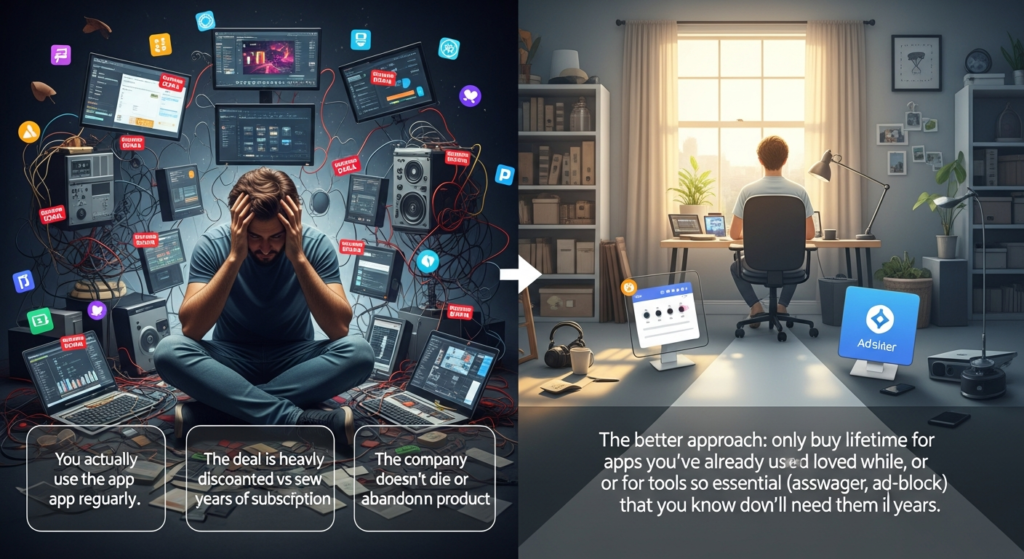
This is how you end up with ten “lifetime” tools and no actual workflow. Long‑term, lifetime is cheaper only if three things are true: you actually use the app regularly, the deal is heavily discounted vs a few years of subscription, and the company doesn’t die or abandon the product. The better approach: only buy lifetime for apps you’ve already used and loved for a while, or for tools so essential (password manager, ad‑block) that you know you’ll need them for years.
“Subscriptions are a scam; always choose lifetime.”
Subscriptions are annoying, yes, but not always a scam. Some apps have genuine ongoing costs — servers, support, external APIs. Reports on subscription app behavior show that many productivity and SaaS‑style tools only survive because pricing is recurring. Lifetime in those cases can be risky; If too many people pay once and never again, the product stagnates or the company is forced to split features into new paid tiers. Realistic view: lifetime for stable utilities, subscription when constant cloud or heavy infrastructure is involved.
“Lifetime means you get all future features forever.”
That’s the dream version. Reality: lifetime often means “access to current and incremental updates,” not “guaranteed full access to any new product spin‑off we invent.” Deal platforms and app blogs warn that companies sometimes release new versions or tiers and keep lifetime licenses only on older plans. If the deal explicitly says “lifetime including all future major versions,” great. Otherwise, assume “lifetime for this plan only.”
“Lifetime deals are only for foreign SaaS; Android users don’t need this.”
Not true. 2026 content specifically targeting Android users in India talks about lifetime deal apps and one-time purchase apps as a way to escape monthly micro-subscriptions. Indie app deals, StackSocial bundles, and mobile‑friendly lifetime licenses for tools like AdGuard show that this world absolutely includes Android. The trick is picking deals that actually improve your daily phone usage, not tools that live only on desktop.
THE PRACTICAL PART WHAT TO ACTUALLY DO
- Audit your current app spending and habits
Open Play Store → Payments & subscriptions → Subscriptions. List what you’re paying for monthly or annually, and how often you actually use each app. Then note which categories you use every single week — things like notes, file management, reading, blocking ads, or focus tools. These are your lifetime deal candidates; everything else can stay subscription or free. - Pick 2–3 high-impact categories to “lock in” first
Don’t go hunting every lifetime deal group on Telegram. Instead, choose a small set where “pay once” really helps: maybe a launcher, a file manager, a PDF/signing app, or an offline note app. Search Indian/Android blogs that specifically discuss lifetime deal apps and one‑time purchase apps for Android — they often highlight exactly these kinds of tools. Start there instead of random categories you don’t even use yet. - For Play Store apps, look for one-time unlocks with a history
When you find a promising app, check: how old is it, when was the last update, and how do Play Store reviews look over the last 6–12 months? Apps featured in “best lifetime apps/pay once” lists tend to be ones that have been around and maintained for years. If an app is new and asking for a lifetime unlock, wait. Let someone else be the early investor. - For external lifetime deals, buy only what you’ll use monthly
If you’re checking platforms like StackSocial or similar deal aggregators, treat them like D‑Mart, not a buffet: go in with a list. Look specifically for Android‑friendly tools (ad‑blockers, VPNs, productivity apps) that you already know, or that have strong independent reviews. If you can’t see yourself opening the app at least weekly, skip the lifetime deal even if the discount looks crazy. - Ignore “lifetime” for unstable categories
Anything that depends heavily on third‑party APIs or expensive infrastructure — like some AI tools, storage, streaming, or sketchy “lifetime VPN forever” — should make you cautious. Deal analysts note that lifetime pricing for these is often unsustainable, which means the company later restricts lifetime plans or shuts down. For these, use monthly or yearly plans, or stick with free tiers from strong providers instead of betting on “forever.” - Think in 2–3 year horizons, not “till old age”
When deciding on a lifetime deal, do a simple check: if I use this app for 2–3 years, does the lifetime price beat 2–3 years of subscription? Deal blogs explicitly say that for apps you know you’ll use at least two years, a 50%+ off lifetime price is usually worth it. That way, even if the app dies after 3–4 years, you still got fair value instead of betting on decades. - Cap your “lifetime budget” so the irony doesn’t hurt
Set a simple rule like: “Max 1–2 lifetime purchases per year under ₹1,000 total.” That forces you to prioritize. When the 3rd “unbelievable lifetime deal” appears, you’ll have to ask yourself: is this really better than the two I already got? The goal is to reduce recurring payments, not replace them with one-time impulse purchases that quietly add up.
QUESTIONS PEOPLE ACTUALLY ASK
What are the best lifetime deal apps for Android?
The best ones are usually boring, essential tools you use daily: premium file managers, launchers, note apps, PDF tools, and utility apps that unlock via a one‑time payment on the Play Store. On the services side, lifetime deals from platforms like StackSocial for things like ad‑blockers or productivity suites can also be valuable if they have good Android apps and strong independent reviews. The key is that you actually use them regularly, not just grab them because the word “lifetime” looked shiny.
Are lifetime subscription apps really worth it?
They can be. Deal‑focused blogs and indie‑app writers say lifetime deals are worth it when the discount is large and you’re confident you’ll use the app for at least 2–3 years. For tools you open every day, a one-time payment can beat multiple years of subscription. But there’s always risk: the app could stagnate, lose features, or the company might pivot to a new product, leaving lifetime users on “legacy” plans.
How do I find genuine lifetime deal apps for Android?
Start with two sources: Play Store apps that clearly offer a one-time “Pro unlock,” and reputable deal blogs/platforms that list lifetime deals with transparent terms. Look for posts specifically about “best lifetime deal apps for Android” or “pay once keep forever” apps — they usually highlight tried‑and‑tested tools rather than random new launches. Avoid any deal where the company has no website, no reviews, or vague lifetime language.
Do lifetime app deals actually last forever?
They last as long as the app and the specific plan exist. In practice, that means: as long as the company doesn’t shut down, sunset the product, or move important features into a new paid tier. Many lifetime deals continue to work for years, but some end up as “classic” versions with only maintenance updates while new features go to subscription plans. That’s why you should evaluate lifetime deals based on 2–3 years of value, not romantic “forever.”
Are lifetime deals better than monthly subscriptions for students?
They can be, especially in India, where paying a one-time ₹200–₹500 for a core app is easier than committing to monthly auto-debits. Student-friendly tech blogs in 2026 explicitly pitch lifetime deal apps as a way to escape subscription overload. But if you’re experimenting with different tools or only need an app for one semester, a short subscription or even a free alternative might be smarter.
How do I avoid getting scammed by fake lifetime deals?
Check three things: the platform, the product, and the fine print. Use known deal platforms (StackSocial‑type sites), look for apps that already have a solid presence and reviews, and read the lifetime terms carefully. Be wary of “lifetime” deals on unknown apps with no public reputation or very vague promises. If the website looks like it was built yesterday and only talks about discounts, you don’t need to be the first buyer.
Do Android developers still offer one‑time purchase instead of subscription?
Yes. Even with the subscription wave, many Android devs still prefer one‑time unlocks for certain types of apps — especially utilities, launchers, icon packs, and some productivity tools. Some dev commentary suggests lifetime/one-time pricing still works when development is manageable and server costs are low. For cloud‑heavy apps, subscriptions are more common because of ongoing infrastructure costs.
What’s better for Android: lifetime deal or family/shared subscription?
If your whole family or friend group uses the same service heavily — like storage, music, or a password manager — a shared subscription can sometimes beat lifetime pricing, especially when the subscription supports multiple users. Lifetime is stronger when it’s just you, the app is essential, and you’re sure you’ll keep using it for years. Think of lifetime as personal ownership, and family plans as shared rent.
SO WHERE DOES THIS LEAVE YOU?
You’re not going to stop the world from moving to subscriptions, but you also don’t have to pay rent on every single app on your phone. That’s the real space lifetime deal apps occupy.
If you’re an Indian 18–25‑year‑old, the sweet spot is small: a handful of Android apps and services you use constantly, where a one‑time payment or a good lifetime deal actually saves money over a few years. For everything else — experimental tools, trendy AI stuff, niche apps for one semester — short subscriptions or free alternatives are less risky.
If you want one concrete move today, it’s this: pick just one category you use daily on your phone (file manager, launcher, notes, PDF, or ad‑blocking), research a solid one‑time or lifetime option for that, and lock that in. When you feel how nice it is to have one core tool fully paid for and off your mental list, you’ll know which app deserves to be next and which subscriptions you’re fine letting die.
You made it through an article about pricing models, which means you either really hate subscriptions or you’re planning to start a “SaaS is theft” YouTube channel.
Lifetime deal apps for Android won’t save you from every future price change, but they can give you something apps rarely give any more: finality. One payment, one decision, one less thing quietly billing you at 3 AM. The trick is to treat “lifetime” like a commitment ceremony, not a flash sale. Choose slow. Pay once. Actually use the thing.
Everyone else can keep chasing the next free trial. You’ll be over here, using the same three paid apps for five years and not needing a spreadsheet to remember what you owe them.