If you’re between 18 and 25 in India and into tech, you already know this: gaming isn’t “a hobby” anymore, it’s what you do when your brain refuses to open a PDF.
You pull out your phone “for five minutes” and suddenly the sun has moved and your charger is at 3%.
This site is for people like you Indian tech users who want practical, real setups, not fantasy builds priced like they assume you own a startup.
And mobile gaming is where most of you actually live now: BGMI in the metro, COD Mobile in the hostel, Subway Surfers when the Wi‑Fi dies.
Here’s the annoying part: everyone talks about 1 lakh PC setups and 60k iPhones, while most students are trying to squeeze gaming performance out of a 8–12k phone, a noisy fan, and exactly one working charging cable.
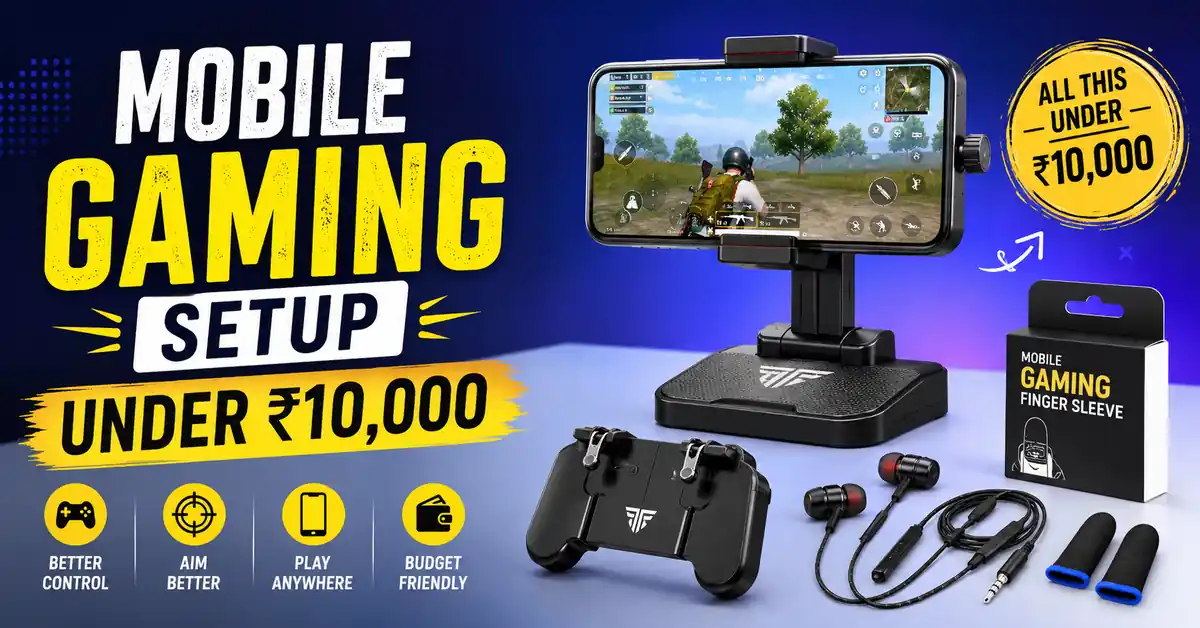
So this isn’t about “best gaming phone ever.” This is about: with a total budget of ₹10,000, how do you build a mobile gaming setup that feels smooth, doesn’t fry your phone, and doesn’t make your ears cry after 30 minutes?
You’re not chasing 240 FPS. You just want to stop lagging every time someone throws a smoke.
THE THING NOBODY ACTUALLY SAYS OUT LOUD
Let’s just say it: if your total budget is ₹10,000, you’re not getting a “pro gamer” setup.
You’re trying to stop your mid-range Android from turning into a tandoor during ranked.
Most advice you see online assumes the phone is already sorted.
Reality? For a lot of Indian students, the phone itself is in that 8–12k range — stuff like Tecno Pova series, Infinix Hot, Redmi 14C, realme C series — which can game decently but only if you stop abusing it.
Here’s the quiet truth: your gaming experience isn’t ruined by “bad hardware” as much as by three things overheating, trash network, and your own chaotic setup.
You play while charging. You’re on the hostel Wi‑Fi that 40 people are streaming on. Your screen is greasy, your phone case is trapping heat, and your ping is doing stand-up comedy.
Nobody wants to admit that the cheapest performance upgrade is changing the way you use what you already have.
Think about it.
You’ll happily watch 10 gear videos, but won’t spend 15 minutes fixing your room’s Wi‑Fi position.
You complain your phone can’t handle BGMI at 60 FPS, but you’re playing under a fan that keeps cutting your audio, on a metal bed that vibrates like an earthquake every time someone opens the door.
And you know that friend who always tops the lobby with some ₹9,000 phone, default earbuds, and zero drama?
That’s your proof.
The normal article will tell you: “Buy this gaming phone, this RGB cooler, this mechanical keyboard, these fancy thumb sleeves.”
Nice, but most 18–25-year-olds in India are juggling UPI limits, monthly allowances, and “bro pay me back” reminders.
Your real constraint isn’t just money.
It’s space (hostel room, shared bedroom), noise (parents, roommates), unstable power, and the fact that you can’t just order a 3k accessory that does only one thing.
So this setup under 10k has to do three jobs at once:
- Make your current phone usable for gaming without killing it.
- Improve comfort so your hands and ears don’t hate you.
- Fix the boring, unsexy stuff — heat, ping, clutter — that actually decides whether you clutch or choke.
The joke is: once you accept you’re not building a YouTube thumbnail setup and focus on these dull details, your games suddenly feel way more “expensive” than your budget.
HOW THIS ACTUALLY WORKS THE REAL MECHANICS
Under ₹10,000, you’re not building a shrine to gaming.
You’re building a system: phone + network + ergonomics + audio + power management.
Start with the phone you already have.
If it’s a recent budget device (say a Tecno Pova, Redmi 14C, Infinix Hot 30i, realme C63) with at least 4–6 GB RAM, 90 Hz or 120 Hz screen, and a decent chipset, it’s already serviceable for most popular games BGMI, Free Fire, COD Mobile, Asphalt.
India’s mobile gaming spend crossed around 400 million dollars in 2024, and most of that isn’t from people using flagship phones. That should tell you something.
Then comes the part nobody glamorises: network.
Most mobile gamers are either on cheap broadband with a basic router thrown in, or 4G/5G data with Jio, Airtel, or VI.
India is literally leading the world in mobile game downloads and a big chunk of those players are 18–34, so yes, the network is crowded.
Good luck hitting perfect ping in the evening without doing anything about your router position or data usage.
The niche angle here — the thing generic “gaming setup” articles skip is:
For mobile gaming under 10k, spending on a better layout and a couple of right accessories gives you more “performance” than throwing everything at a new phone.
Some stuff that quietly matters:
- A decent wired earphone: more audio detail, less delay than cheap Bluetooth, zero battery stress.
- A stand or mount: keeps your posture sane and hands relaxed.
- Cooling: not always a fancy cooler; sometimes it’s as simple as ditching the thick case and playing near a fan.
- A backup power plan: think 10,000 mAh power bank instead of torturing your phone with hot fast-charging mid-match.
Here’s a blunt list of how your money actually works for you under 10k:
- Phone optimisation, not replacement.
If your phone is less than 2–3 years old, you usually gain more from cleaning storage, killing background apps, and lowering graphics than from daydreaming about a new phone you can’t afford anyway. This is boring, which is why it works. - Network sanity.
Shifting your router by 2 meters, switching to 5 GHz if available, or playing near a window on mobile data often drops your ping more than any “gaming mode” in your phone settings. Nobody flexes this on Instagram, but they should. - Ergonomic comfort.
A ₹300–600 phone stand, a basic wrist-friendly position, and a bed that isn’t shaking every time your roommate moves will save you from random mis-taps more than that ₹1,500 “pro” finger sleeve pack. - Audio that doesn’t suck.
A decent budget IEM or wired earphone under ₹700–₹1000 gives you directional sound, clear footsteps, and mic clarity for calls. That’s a bigger real-world advantage than some fake-7.1 “gaming” branding on plastic headphones. - Heat control.
You can’t expect consistent FPS if your phone’s back panel feels like a dosa tawa. Simple habits — not playing while charging, lowering brightness, using a thinner case — take you further than slapping on random coolers you found on sale.
Once you see the setup as these moving parts instead of a “one purchase fixes life” fantasy, your 10k budget stops feeling insulting and starts feeling… workable.
COMPARISON WHAT’S ACTUALLY DIFFERENT BETWEEN YOUR OPTIONS
| Option | What it actually does | Who it’s for | The catch |
| New budget gaming phone (8–10k) | Better chipset, higher refresh rate, more stable FPS | Your current phone is truly dying | Eats 80–100% of budget, no money left for setup |
| Keep phone, buy key accessories | Improves comfort, audio, cooling, and network stability | Phone is decent but games feel inconsistent | Needs small but smart purchases, not random ones |
| Split budget: phone + small gear | Slight phone upgrade plus basic earphones/stand/power bank | You want balance and can stretch to 10k max | Phone may still be mid, upgrades feel less dramatic |
| Spend mostly on accessories only | Turns a mid phone into a more “competitive” setup | Already fine with device, want better feel | Won’t fix a truly weak chipset or 2 GB RAM phone |
If you’re expecting me to be neutral here, sorry.
If your current phone is not ancient and has 4–6 GB RAM, I’d push you towards keeping the phone and building a smart accessory-based setup — because that’s where under-10k budgets actually punch above their weight.
WHAT ACTUALLY HAPPENS WHEN YOU TRY THIS
When you actually try building a mobile gaming setup under 10,000 in India, it doesn’t feel like a tech project.
It feels like negotiating with real life.
You start with a list: maybe ₹700–₹1,000 for wired earphones, ₹400–₹700 for a stand, ₹1,200–₹1,800 for a power bank, ₹400–₹700 for a basic cooling/airflow solution, and the rest reserved for “just in case” — which becomes food within 3 days, obviously.
You order something during a sale, it lands late, your parents ask why you need “another earphone,” and your roommate immediately wants to borrow it.
The first real change you feel is audio.
Going from random Bluetooth buds with half-a-second delay to a decent wired pair is like switching from Doordarshan to HD streaming.
Suddenly you can hear footsteps, reloads, and distant vehicles properly. Your KD doesn’t skyrocket, but you stop dying to people who you never heard coming.
Then you fix how you hold and place your phone.
The stand or mount seems unnecessary until you actually put it on your desk and lean back in your chair instead of hunching over your bed.
Your thumbs move more freely, less accidental touches, you’re not suffocating the side where the phone actually dissipates heat.
What surprised me the most the first time I tried a “budget but optimised” setup wasn’t the FPS change.
It was how relaxed longer sessions felt.
Your hands don’t cramp as fast. Your neck doesn’t hate you. Your phone stays warm, not boiling.
And here’s the pattern most other articles miss: the enemy of budget gaming isn’t low specs, it’s inconsistency.
Some matches feel perfect. Others lag, stutter, drop, freeze. Nothing changed except… everything did.
Wi‑Fi got crowded, your phone was hotter than usual, you started matchmaking at 10 PM when every bored student in India logged in at the same time.
When you actually optimise with this 10k ceiling in mind, what improves is your floor, not just your ceiling.
Your worst matches become less painful. Your average becomes stable. Those random drops in performance become rare instead of normal.
There’s also a quiet psychological shift.
Knowing you’ve done the basics right — clean network, stable stand, decent sound, power bank on standby — reduces that permanent low-level frustration.
You stop blaming “lag only for me bro” for every loss and start actually reading your mistakes.
No, this doesn’t turn you into a pro player.
But it does something more important at this budget: it makes gaming feel like a choice again, not a fight against your own hardware every single night.

THE ADVICE EVERYONE GIVES VS WHAT ACTUALLY WORKS
Common advice 1: “Just buy a gaming phone, bro.”
This assumes you have 15–20k lying around and your only problem is FPS.
If your total budget is 10k, dropping almost all of it on a new device leaves you with the same bad network, same heat issues, same uncomfortable grip, and the same charger-from-2018 drama.
What actually works: If your phone is less than 2–3 years old with 4–6 GB RAM, stick with it. Focus your money on accessories and optimising settings. If your phone is genuinely unusable — constant frame drops even on low settings, battery health gone — then consider a budget gaming phone in the 8–10k range, but accept that you’ll be running barebones for accessories for a while.
Common advice 2: “Use mobile data for lowest ping, always.”
Mobile data can be good, especially 5G in metro areas, but it’s not magic.
You’re sharing towers with half the city, speeds fluctuate, and if your room is a dead zone, you’re stuck regardless.
What actually works: Test both — your broadband Wi‑Fi and your mobile data — at the actual place and time you usually play. Use in-game network graphs or speed tests. Sometimes a cheap JioFiber plan with the router moved closer beats random 5G inside concrete walls. Sometimes the opposite happens and data is smoother. Treat it like a science experiment, not religion.
Common advice 3: “Buy ‘gaming’ accessories only.”
Anything with RGB and a “GAMING” sticker is not automatically good.
A lot of budget “gaming” earphones and coolers are badly tuned, uncomfortable, or just cheaply built.
What actually works: Look for value, not just labels. A simple, well-reviewed wired earphone from brands known for audio can outperform a flashy gaming headset at the same price. A basic metal or ABS phone stand is better than an overcomplicated “gaming dock” that wobbles. Make every accessory do at least two things well: performance + comfort, or comfort + durability, or durability + multipurpose use.
Common advice 4: “Max out graphics for better experience.”
Sure, Ultra HD looks pretty — right before your match turns into a slideshow.
Pushing your budget phone to max graphics is like asking an auto-rickshaw to win an F1 race.
What actually works: Balance. For most budget phones, 40–60 FPS on smooth/low or balanced graphics feels far better than inconsistent 30 FPS on extreme visuals. Lower shadows, reduce effects, cap FPS to what your phone can sustain without overheating. Smooth + stable beats pretty + random every single day.
THE PRACTICAL PART WHAT TO ACTUALLY DO
- Audit your current phone before buying anything.
Check your storage — keep at least 15–20% free. Delete junk, uninstall unused apps, move photos to cloud.
Update heavy games only on Wi‑Fi and avoid running multiple big apps in the background.
Then open your main game and tweak settings: turn off unnecessary animations, reduce graphics one step, and test FPS and heat over 30–40 minutes. This gives you a baseline before spending a rupee. - Fix your network the boring way.
If you use Wi‑Fi, move the router to a more open spot — higher shelf, less blocked by walls.
Switch to the 5 GHz band if your router and phone support it; it’s usually faster but has less range.
If you depend on mobile data, play near windows or open spaces, away from thick walls. Run 2–3 speed tests at your usual gaming time and pick the connection with the most stable ping, not just peak speed. - Buy one solid wired earphone or IEM in the ₹500–₹1000 range.
Prioritise clear mic and comfort over “bass boosted gaming monster” marketing.
Use it for calls, movies, classes, and gaming — this way you’re not buying a one-trick gadget.
A decent wired set will cut latency, improve footsteps, and let you hear more of what’s actually happening around you in-game, which matters more than you think in BR and shooters. - Get a simple, sturdy phone stand and fix your posture.
Look for a basic adjustable stand that can hold your phone both horizontally and vertically.
Keep it on a table or desk so your arms rest naturally, not floating awkwardly over your stomach.
Play 3–4 matches like this and pay attention: your thumbs move more freely, your neck strain reduces, and your swipes become more consistent. - Invest in a 10,000–20,000 mAh power bank instead of nonstop charging.
Constantly gaming while plugged into a wall charger heats up both the phone and the adapter.
With a power bank, you can charge in between sessions or during lighter games, instead of mid-fight when everything’s already hot.
Avoid the cheapest unnamed brands; go with something with basic safety features and decent reviews so it doesn’t die in six months. - Create a “gaming mode” for your room.
No, not RGB strips.
Pick one spot — a chair + table, or a corner of the bed near a plug and fan — and keep your stand, earphones, and power bank there.
Tell people you live with that after a certain time, that corner is where you’ll be, so they don’t keep shifting the router or stealing your charger. Tiny, boring systems like this are what actually make gaming consistent. - Set a realistic upgrade path, not a fantasy wishlist.
If you know your phone will need replacing in a year, don’t pretend you’re saving for an iPhone while spending everything on impulse buys.
Plan it: this year, accessories and network. Next major sale, look for a mid-range upgrade if your finances allow.
This way, your 10k setup today still makes sense when you eventually get a better phone — nothing goes to waste.
QUESTIONS PEOPLE ACTUALLY ASK
how can i build a gaming setup with just 10000 rupees
You treat the 10k as a total ecosystem budget, not just “new phone or nothing.”
Start with your existing phone, optimise settings, clean storage, and fix your network.
Then spend on a wired earphone, a stand, and a power bank, all in the sensible budget range.
Only if your phone is truly unusable do you throw most of the budget at a new device and accept minimal accessories for now.
which is more important for mobile gaming under 10000 phone or accessories
If your phone is ancient or stuck at 2–3 GB RAM, the phone matters more you need a baseline that can handle modern games.
But if you already own a recent budget phone with 4–6 GB RAM, accessories will give you more noticeable improvement for less money.
Better audio, comfort, and heat management make your current hardware feel more capable.
So in most student cases, accessories first, upgrade later when absolutely necessary.
are gaming earphones under 1000 rupees even worth it
Yes, if you pick them for sound and comfort, not just RGB or “gaming” tags.
Under ₹1000 you won’t get audiophile-level quality, but you can absolutely get earphones with clear mids and decent positional cues.
Look for wired options with a mic and good real reviews rather than just influencer hype.
They’ll be better than generic freebies and random ₹150 bus-stand specials.
will a cooling fan or cooler really help my budget phone
It can help, but it’s not magic.
If your phone is overheating because you’re playing at max graphics while charging, no cooler will fully save you.
Clip-on coolers help keep temperatures slightly lower, which can stabilise FPS over long matches, but they work best when you’re already being sensible about brightness and settings.
Think of them as an extra layer, not a cure for abusing your phone.
can i play bgmi smoothly on a phone under 10000
Yes, but not at ultra settings with everything maxed out.
Phones in the under-10k bracket like some Tecno Pova, Infinix, and Redmi models can handle BGMI on smooth or balanced graphics with medium to high FPS, depending on the chipset.
The key is sustainable performance lower your graphics one step, cap FPS to what the device can hold, and keep the phone cool.
Do that and it’s absolutely playable for most casual and mid-level players.
how do i reduce lag in mobile games without buying new phone
First, fix your network: closer to the router, better position, 5 GHz if available, or a stronger mobile signal spot.
Then close background apps, clear cache, and avoid using social media or streaming in the background while gaming.
Lower in-game graphics, disable unnecessary effects, and turn off “auto-download updates” in the background.
These small tweaks often cut lag way more than you expect, especially on budget phones.
is it better to use wifi or mobile data for gaming in india
It depends on where you live and how your home is set up.
In some areas, fibre Wi‑Fi with a decent router gives more stable ping and less packet loss than mobile data, especially at peak times.
In others, good 4G/5G data near a window beats a cheap, badly placed router.
Test both at your usual playtime and pick the one that feels consistently smoother, not just faster on a single speed test.
is mobile gaming even worth investing money into as a student
If it’s your main way to relax, socialise with friends, or unwind after classes, it’s valid to invest a bit the same way people spend on books, sports gear, or Netflix.
The key is setting a hard limit like 10k and not letting it creep into “one more upgrade” land.
Buy multipurpose stuff: earphones you can use for classes, a stand you can use for studying, a power bank that saves you on trips.
Then it stops feeling like “wasted” money and becomes part of your overall tech setup.
SO WHERE DOES THIS LEAVE YOU
You’re not getting a dreamy esports setup for ₹10,000.
You’re getting something more boring and more useful: a mobile gaming setup that actually fits how Indian students and young adults live.
The market loves to talk about billion-dollar growth and “India leading global mobile downloads,” but your reality is: shared rooms, noisy homes, limited money, and one phone that does literally everything gaming, banking, college, and doomscrolling.
Under that pressure, chasing perfection is a nice way to end up frustrated and broke.
So here’s the one concrete thing you can do today: pick one weak link audio, network spot, or posture and fix just that this week.
Buy a solid wired earphone, or move your router, or get a simple stand and claim one corner of your room as “gaming mode.”
It won’t magically turn you into a god-tier player, but you’ll feel the difference in the next few matches.
It’s not perfect.
It won’t look like the setups on YouTube thumbnails.
But it’ll be yours, it’ll work, and it won’t require selling your kidney on OLX.
You made it this far, which already puts you ahead of half the people still arguing in comment sections about which brand is “OP.”
You now know what actually matters for a mobile gaming setup under 10k in India: not flex hardware, but smart, dull decisions that make your phone, your network, and your body work together instead of fighting each other.
If you forget everything else, remember this line: smooth, stable, and comfortable beats flashy, hot, and inconsistent every single time.
Your setup is allowed to be modest as long as it’s intentional.
So go tweak a setting, shift a router, add one accessory that pulls double duty, and see how your next session feels.
No guarantees, no dramatic promises just a slightly better version of what you already do every night when you say, “One last match,” and absolutely lie.
_