Introduction
Smartphones today are personal vaults. They store your biometric data, financial credentials, and private chats. They also hold your browsing patterns and health records.
For years most smart features relied on cloud servers. Voice recognition, photo tagging, and spam filtering all sent your data to remote servers for processing. Most people never knew this was happening.
On-Device AI changes everything. Instead of sending your data to distant servers, your phone now processes everything locally. This shift directly impacts your privacy, speed, and security.
I reviewed multiple Android and iOS devices over the past few years. I noticed a clear difference between phones that depend on cloud processing and phones optimized for local processing. Features like offline voice typing and instant face unlock were noticeably faster on devices with strong neural engines.
They also kept working when the internet dropped. That reliability showed me the real practical value of local intelligence.
What Is On-Device AI?
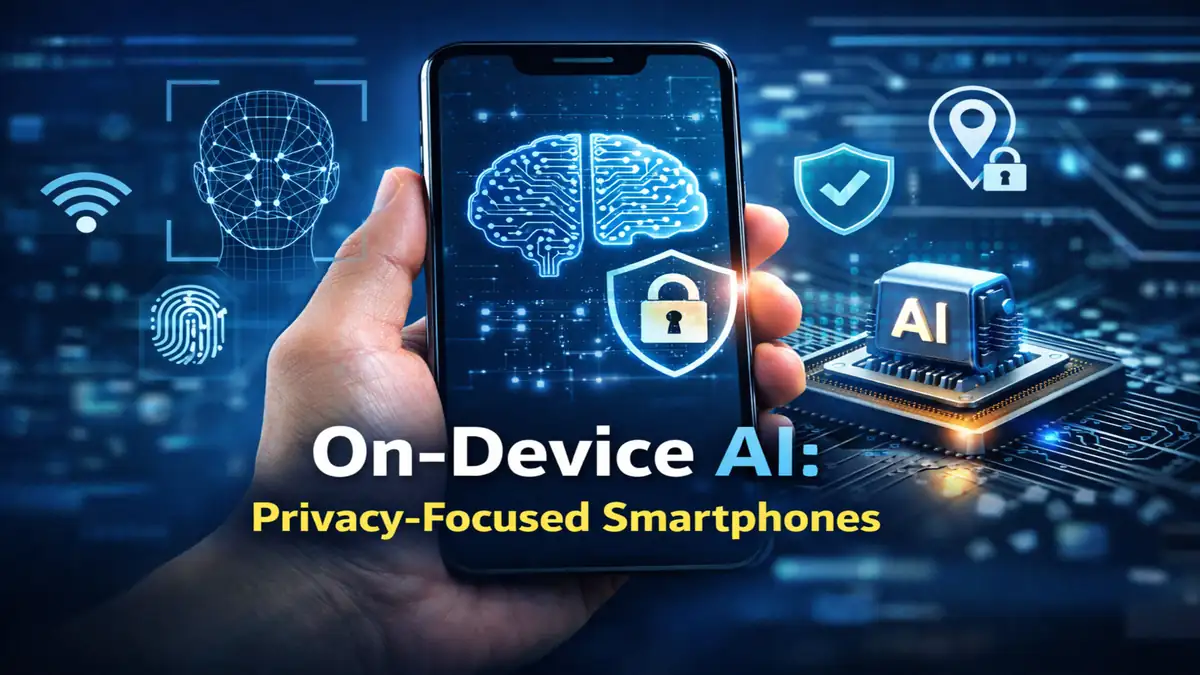
On-Device AI means artificial intelligence models run directly on your smartphone hardware. They do not rely on remote servers to work. Everything happens right on your device.
This applies to inference workloads specifically. Model training still happens in data centers. After training, compressed optimized models get deployed directly to your phone.
Modern chipsets include dedicated hardware for machine learning tasks. Apple, Qualcomm, and Google all embed neural processing units into their chips. These components handle AI tasks far more efficiently than regular processors.
Face recognition runs locally inside secure hardware. Wake word detection works without any internet access. Camera apps apply AI driven noise reduction in real time. Predictive text works without ever transmitting your keystrokes anywhere.
The practical result is less dependency on continuous internet connectivity.
Hardware That Makes On-Device AI Possible
On-Device AI only works because of specialized hardware inside modern phones. Without this hardware local AI processing would be too slow and too power hungry.
Neural Processing Units
NPUs are optimized for the parallel computations neural networks require. They outperform regular CPUs significantly in AI inference tasks. They also consume much less power while doing it.
Secure Enclaves and Trusted Execution Environments
Sensitive AI tasks like biometric authentication run inside hardware isolated security zones. These enclaves prevent raw biometric templates from ever being extracted. Your face data and fingerprint data never leave this protected space.
Memory Bandwidth Optimization
AI inference needs very fast memory access. Modern smartphones use high bandwidth memory combined with cache systems tuned specifically for AI workloads. This keeps inference fast and efficient.
Model Compression Techniques
Running full AI models on a phone requires serious optimization. Techniques like quantization, pruning, and knowledge distillation reduce model size dramatically. Accuracy stays high while the model becomes small enough to run locally.
I tested phones with stronger NPUs during real world photo processing tasks. They handled sustained load consistently without slowing down. Older devices throttled quickly under the same workload.
Privacy Advantages of On-Device AI
This is where On-Device AI truly changes the game for users. Local processing means your data stays on your device. It never travels anywhere it does not need to go.
Reduced Data Transmission
If speech to text processing happens locally, your raw audio never gets uploaded anywhere. Fewer transmissions mean fewer points where your data can be intercepted. This is a significant privacy improvement over cloud based processing.

Minimized Data Retention Risks
Cloud based AI services often store your data temporarily for model improvement. On-device processing removes dependency on these retention pipelines completely. Your data gets processed and stays on your phone.
Stronger Regulatory Compliance
Data protection regulations are getting stricter worldwide every year. Minimizing cross border data transfers makes compliance much simpler for developers. On-device processing helps apps stay on the right side of these laws.
Limited Behavioral Profiling
When personalization runs locally, large scale aggregation across millions of users becomes much harder. This directly changes the data economics of surveillance based business models. Your behavior stays yours instead of becoming part of a massive dataset.
I tested offline voice dictation on newer devices specifically to check this. Transcription worked accurately without any internet connection at all. That confirmed the model was running locally without sending any requests to remote servers.
Real World Use Cases of On-Device AI
Biometric Authentication
Fingerprint and facial recognition rely entirely on secure hardware modules. Your biometric templates stay encrypted on the device always. They never leave your phone under any circumstances.
AI Powered Camera Processing
Night mode, HDR merging, and scene detection all run locally on your phone. This gives you instant results without any upload delays. Responsiveness feels immediate because nothing is waiting for a server response.
Spam and Fraud Detection
On-device classifiers flag suspicious SMS messages without routing your entire message database to remote servers. Your private messages stay private. The AI reads them locally and never sends them anywhere.
Predictive Text and Personalization
Modern keyboards use compact language models stored entirely on your device. This eliminates privacy concerns about transmitting your keystrokes to servers. Everything you type stays on your phone.
Health and Activity Monitoring
Wearable integrations increasingly analyze biometric patterns locally first. Only summarized insights get synced to the cloud afterward. Your raw health data never leaves your device.
Performance and Latency Benefits
Local inference eliminates network round trip time completely. For tasks like augmented reality overlays or live translation, every millisecond matters. Cutting out the server round trip makes a noticeable real world difference.
I compared live translation features across multiple devices. Offline capable models responded faster and more consistently in weak network areas. Cloud dependent models became unreliable the moment signal dropped.
Battery efficiency improves too. Data transmission is power intensive. Optimized NPUs perform the same computations at much lower energy cost than continuous wireless data transfer.
Security Benefits Beyond Privacy
On-Device AI contributes to broader mobile security in several important ways. Real time anomaly detection for apps runs locally without external communication. Local malware behavior analysis catches threats faster than cloud based scanning.
Phishing detection inside browsers works even without internet access. App permission monitoring uses behavioral AI models that operate without transmitting complete logs anywhere. Security gets faster and more private at the same time.
Limitations of On-Device AI
On-Device AI has real limitations that are worth understanding honestly. Smartphones have finite memory. Large language models cannot run at full scale locally without heavy compression that affects capability.
Cloud models can be updated centrally at any time. On-device models require full software updates to improve. This makes them slower to evolve than cloud based alternatives.
Performance varies widely between budget and flagship devices. A feature that runs smoothly on a premium phone may struggle on a mid range device. Hardware fragmentation is a genuine challenge for developers.
Training also still happens in data centers entirely. On-device AI only handles inference. The learning process itself remains cloud dependent.
I tested advanced on-device video enhancement on older mid range devices during extended testing. They struggled significantly with sustained workloads. The hardware dependency is very real and very visible.

The Future of On-Device AI and Privacy Focused Smartphones
Advancements in model optimization and silicon design keep pushing more intelligence toward the device. Hybrid architectures are emerging that process sensitive data locally while contributing anonymized signals to broader model improvements.
Federated learning lets models improve without centralizing raw user data anywhere. Differential privacy adds statistical noise before any aggregation happens. These techniques make on-device AI smarter without compromising privacy.
Regulatory scrutiny is increasing globally every year. Manufacturers now have strong incentives to minimize centralized data collection. On-Device AI is becoming a key differentiator in premium smartphones.
The phones winning the next decade will be the ones that do the most intelligence locally. Privacy is becoming a feature people actively choose. Companies that ignore this will lose users to those that prioritize it.
Conclusion
On-Device AI is a fundamental redesign of how smartphones work. Instead of depending on continuous connectivity and centralized processing, it prioritizes local computation and data minimization. Your data stays on your device where it belongs.
For privacy focused smartphones this shift is not optional. It is foundational. Devices with strong NPUs, secure enclaves, and optimized local models will define the next generation of personal computing.
The best smartphone is not the one with the fastest internet connection anymore. It is the one that needs the internet the least.
Frequently Asked Questions
Is On-Device AI completely private?
It significantly reduces data transmission but does not guarantee absolute privacy. App permissions, telemetry settings, and manufacturer policies still matter. Always check what permissions an app is requesting before installing it.
Does On-Device AI work without internet access?
Many inference tasks like face unlock and offline speech recognition work without any connectivity at all. Cloud dependent features may still require internet to function. Check your device specifications to know which features work fully offline.
Is On-Device AI slower than cloud AI?
For latency sensitive tasks it is often faster because it completely avoids network delays. Large scale generative models may still perform better in the cloud due to size limitations. The speed advantage of local processing is most visible in real time tasks.
Do budget smartphones support On-Device AI?
Most modern devices include basic AI acceleration but performance varies widely by chipset. Budget phones can handle basic tasks like predictive text and face unlock. Advanced features like real time video enhancement require more powerful dedicated hardware.
Can On-Device AI reduce battery drain?
Efficient NPUs perform inference at lower energy cost than continuous cloud communication. Heavy AI workloads still impact battery life regardless of where processing happens. Overall battery efficiency improves most for users who previously relied heavily on cloud features.