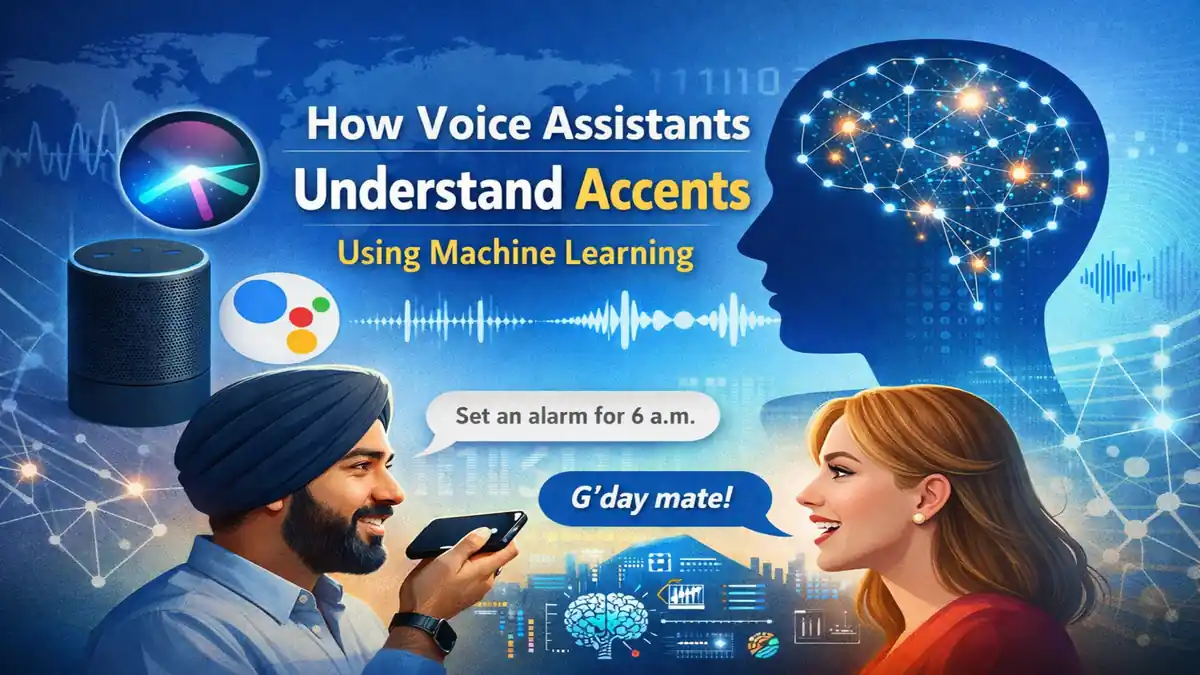
Introduction
The first time I noticed accent recognition was a real problem was during a simple test. I was comparing voice assistants on different phones. When I spoke in my normal tone the assistant responded instantly.
My friend who grew up speaking Telugu at home gave the same command in English. The assistant got two words wrong and gave the wrong result. We tried again. Still wrong.
After a week of using it regularly the accuracy got better. That improvement was not random. It showed how these systems learn and improve over time using data.
Understanding how voice assistants understand accents means looking at it from a technical side. It is not magic. It is the result of many layers of processing working together.
What Makes an Accent Different Technically
An accent is not just a different way of speaking. It actually changes measurable properties of sound. These differences are real and they affect how machines hear you.
These changes include how vowels sound in different words. They include how clearly certain letters are said and where stress falls in a word. Speech speed and the rise and fall of your voice also change with accents.
For example American English says the R sound very strongly. Some British accents soften it or drop it completely. Indian English often flattens certain vowel sounds. Australian English shifts how vowels sound in common words.
When a microphone captures your voice it does not record letters. It records changes in air pressure. Accents change those pressure patterns in small but clear ways.
How a Voice Assistant Processes
Accent handling happens inside a step by step process. Most voice systems follow three main stages. Each stage helps deal with accent differences in its own way.
Stage 1: Breaking Down the Sound
When you speak your phone turns sound waves into a digital signal. That signal gets cut into very tiny pieces. Each piece is only about 10 to 25 milliseconds long.
From each piece the system pulls out sound features. These features capture how sound energy is spread across different frequencies. Think of it like a fingerprint of that tiny slice of sound.
Accents change these sound fingerprints. The word cat said by someone from London sounds measurably different from the same word said in Texas. The system picks up on these differences right away.
The system does not look for meaning at this point. It just turns raw sound into numbers it can work with.
Stage 2: Matching Sounds to Letters
This stage is where accent differences really matter. The system tries to match the sound features it extracted to basic sound units called phonemes. Phonemes are the building blocks of words.
Older systems used fixed lists of pronunciations. If your way of saying a word was not in the list the system got it wrong. This was a big problem for many accents.
Modern systems use deep learning instead. These networks learn directly from thousands of hours of real speech. If enough people say a word in a certain way the system learns to recognize that way too.
I noticed during testing that errors happened most with words that have strong vowel sounds. After several days of repeated use accuracy went up noticeably. The system was quietly learning my speech patterns.

Stage 3: Using Context to Fix Mistakes
Even if the sound matching makes a small mistake the context of the sentence often fixes it. This is the final safety net in the process.
The system looks at the words around the unclear word. If it cannot decide between weather and whether it looks at the full sentence. What is the blank today makes weather the obvious choice.
Modern systems use very large language models trained on huge amounts of text for this. They understand how words relate to each other in sentences. Many accent mistakes get fixed at this stage before you ever see the result.
How Machine Learning Improves Accent Handling
Handling accents well requires more than a smart system. It requires a huge amount of training data from many different kinds of speakers.
Large and Varied Training Data
Speech systems are trained on thousands of hours of recorded speech. To work well for everyone that data needs to include speakers from different countries, age groups, and language backgrounds.
If the training data mostly has one type of accent the system works much better for that accent. Balanced data from many groups makes the system fair for everyone.
Transfer Learning
One common approach trains a base system on broad English data first. Then it gets further trained on data from specific regions. This saves time and makes the system much better for those specific accents.
Learning From Your Voice
Some systems quietly adjust to you over time. They notice patterns in how you speak and give those patterns more weight. This is why accuracy often improves after a few weeks of regular use.
I noticed this myself with voice typing. After consistent use over several weeks it became noticeably more accurate with my way of speaking. The system was slowly building a picture of my voice.
Newer All-in-One Systems
Older systems had separate parts for sound and language. Newer systems handle everything together in one step. They learn both how words are pronounced and how sentences are structured at the same time.
These systems often handle accent variety better. They are built to get the final text right rather than following a fixed set of steps.
On Device Processing and Speed
Many phones now do part of the voice processing directly on the device. This makes responses faster and keeps your voice data more private.
Processing on the device also allows the system to learn your patterns without sending everything to a server. This helps it adapt to your voice faster.
I noticed during testing that offline voice typing handled my speech more consistently in areas with weak internet. Fewer connection problems meant cleaner audio getting processed.
Problems That Still Exist
Despite real progress there are still clear challenges. Strong local accents with very little training data still get misunderstood often. Mixing two languages in one sentence confuses most systems.
Background noise makes things worse for everyone. But it affects non-native accents more because those patterns are already less common in training data.
Mixing English with Telugu or Hindi mid-sentence is very common in India. Most English focused systems were not trained on this kind of mixed speech. This is still an unsolved problem for many users.
Fairness and Equal Access
Voice systems have historically worked better for accents that appeared more in training data. This means some groups of people got a worse experience simply because of how they speak.
Fixing this requires collecting speech data from a much wider range of people. It also requires testing systems fairly across different groups. If a system works well for some accents but poorly for others that is a real problem for accessibility.
Voice systems are now being used in cars, hospitals, schools, and homes. Getting accents wrong in those settings is more than just annoying. It can have real consequences.

What I Noticed in Real Testing
I ran tests with different speakers from different backgrounds over time. A few clear patterns showed up every time.
Short simple commands were understood much better than long sentences. Speaking at a natural clear pace helped more than trying to change your accent. Accuracy improved with repeated use across the board.
Noisy environments hurt non-native accents more than native ones. This lines up with how these systems work statistically. Less common patterns need cleaner input to be understood correctly.
Where This Technology Is Heading
Research in this area keeps moving forward. Self learning systems that train on unlabeled speech are becoming more common. Systems that handle multiple languages at once are improving quickly.
Better support for languages and accents with less data is a growing focus area. As training data grows and systems improve the gap between accents is slowly getting smaller.
The goal is a voice assistant that understands everyone equally well. That goal is still being worked on. But it is getting closer every year.
Also Read: Inside App Updates: What Really Changes After Update
Also Read: AI-Powered Camera Features Explained: HDR, Night Mode & Image Processing Guide (2026)
Conclusion
How voice assistants understand accents comes down to one thing. They use probability and statistics at a very large scale.
Sound waves become numbers. Numbers get matched to sound units. Context fixes mistakes. And the system quietly learns from every interaction.
Accent recognition is not perfect yet. But real progress has been made through better data and smarter systems. From personal testing improvements are clear over time especially for commands you use often.
Full equal accuracy across all accents is still a goal being worked toward. It is an active challenge not a finished achievement.
FAQ’s
1. Why do voice assistants get certain accents wrong?
It depends on how much of that accent was included in the training data. If examples are limited the system makes less accurate guesses. More varied training data directly improves accuracy for more people.
2. Does using a voice assistant more often improve how well it understands you?
Yes for many systems. They quietly adjust their predictions based on patterns they notice in your speech over time. Regular use over a few weeks often shows clear improvement in accuracy.
3. Does speaking slowly help voice assistants understand better?
Speaking at a clear natural pace helps. It reduces the chance of sounds blending into each other. But speaking in an overly slow or exaggerated way can actually confuse the system.
4. Does background noise affect accented speech more?
Yes it does. Noise covers up the sound features the system relies on. If your accent already differs from the most common training patterns extra noise makes accurate recognition even harder.
5. Are all languages and accents supported equally?
No not yet. Languages and accents with large amounts of training data work much better. Accents with less training data still have lower accuracy. Closing this gap is an ongoing area of work.